Photo by Max Böttinger on Unsplash
When people think about rest, they picture hammocks. Beach vacations. Maybe a long nap on a Sunday afternoon.
They don’t picture strapping into a race car, heart rate climbing, every sense sharpened to a knife’s edge as you barrel toward a corner at 200 km/h.
And yet, after years of researching rest for my book Time Off and spending countless hours in the simulator (and a few hours in real race cars), I’ve come to a conclusion that might sound very odd at first: racing is one of the best rest activities I’ve ever experienced.
Not relaxation. Rest.
There’s a difference, and understanding that difference might change how you think about recovery, performance, and what it actually means to recharge – whether you’re interested in motorsports or not.
The Four Factors of Recovery
In Time Off, my co-author John and I explored what research tells us about proper rest and recovery. Not all rest is created equal, and four major factors particularly contribute to genuine recovery:
- **Relaxation –**allowing our mind and body to wind down
- Control – deciding how to spend our time and attention
- Mastery – being challenged enough to get into a flow state
- Detachment – being so absorbed that we forget about work
If your definition of rest is limited to relaxation, you’re ignoring three-quarters of the essential components. Burning three hours on Reddit is not the same as taking a walk in nature or pursuing a challenging hobby. Good rest is not mere relaxation. It’s active and challenging. It demands our full attention. It stimulates us and gets us into flow states.
Most people intuitively understand the relaxation piece. But control, mastery, and detachment? These are where racing becomes so uniquely suited to rest.
Control: Every Input, Instant Effect
Many factors in our daily lives are beyond our control. Your boss makes a decision that uproots months of work. A client sends new specifications right before a deadline. The world throws curveballs, and we absorb them.
To balance this, good rest returns control back to you. Activities like painting, cooking, or making music are fully in our control. We decide how we spend our time, energy, and attention.
Racing takes this to an extreme.
In a race car, you are the captain. Every single input is your decision – throttle, brake, steering, weight transfer. But it goes beyond mere decision-making. In few other pursuits do your inputs lead to such drastic and immediate effects.
Every tiny movement of your hands or feet instantly translates into the behavior of the car – especially in a high performance race car. Press the throttle a fraction harder mid-corner and the rear steps out. Trail-brake a meter deeper and the nose tucks in. The feedback loop between intention and outcome is measured in milliseconds.
This immediacy is rare in modern life. Most of our decisions play out over days, weeks, or months. We send an email and wait. We launch a project and hope. The gap between action and consequence stretches out, often beyond recognition.
In a race car, that gap collapses to zero. The car becomes an extension of your body, responding to your inputs with absolute fidelity. There’s something deeply restorative about that kind of agency – a reminder that your actions matter, in an immediate and tangible form.
Mastery: The Obsession Over Tenths
True rest involves mastery experiences – activities that are challenging and mentally absorbing enough to get us into a flow state, without being so difficult that we quit in frustration.
Racing hits this balance perfectly, almost by design.
The learning curve in motorsport is infinite. No matter how fast you get, there’s always another tenth of a second to find. Drivers all the way from amateurs to professionals– especially with the rise of sim racing as a highly realistic training tool – spend hours obsessing over the tiniest of details (using increasingly sophisticated tools, like Track Titan, to help them). The optimal braking point. The ideal line through a complex of corners. The precise moment to get back on the throttle.
This obsession isn’t tedious. It’s engaging precisely because the feedback is immediate. The moment you make a mistake or improve something, your lap time delta tells you. Literally within seconds of trying a different approach, you know if it worked.
Few other pursuits provide such clear, immediate feedback. In most creative or professional work, you might not know for weeks whether a decision was right. In racing, you know before you’ve finished the lap.
This rapid feedback loop is one of the key triggers for flow states. Psychologist Mihaly Csikszentmihalyi – the “godfather of flow” – identified it decades ago: when challenge matches skill and feedback is immediate, we’re primed to enter the zone. Racing delivers this combination more reliably than almost anything else I’ve found.
Detachment: No Room for Tomorrow’s Meeting
The final component of good rest is detachment – the ability to put work entirely out of your mind and attend to other things. As organizational psychology researcher Sabine Sonnentag has found, people who experience more psychological detachment during off-hours are more satisfied with their lives and experience fewer symptoms of strain, while also being more engaged at work.
Racing doesn’t just offer detachment, it demands it.
David Heinemeier Hansson – a.k.a. DHH, the legendary programmer who created Ruby on Rails and also happens to be a successful racing driver – captured this perfectly on the Lex Fridman podcast:
“In a race car, it’s not a lottery at all. You sit down in that car, you turn the ignition, you go out on track and I get flow virtually guaranteed because you need, or I need at least 100% of my brain processing power to be able to go at the speed I go without crashing. So there’s no time to think about dinner tonight or the meeting next week or product launch. It’s completely zen in actually, the literal sense of the word.”
This is the key insight. Racing doesn’t just allow detachment – it forces it. You either achieve total presence, or you crash. There is no middle ground.
Most activities allow your mind to wander. You can run on a treadmill while mentally rehearsing a difficult conversation. You can play guitar while worrying about tomorrow’s presentation. The activity occupies your body, but your mind remains partially elsewhere.
Racing offers no such escape route. The stakes are too high, the demands too immediate. Every corner requires your full attention. Every braking zone demands commitment. The worried, planning, ruminating parts of your brain simply get pushed out because there’s no processing power left for them.
This is forced meditation. Enforced presence. And it’s remarkably effective.
Flow or Die
Steven Kotler, who has spent decades researching flow states, noticed something interesting about extreme sports athletes. In his book The Rise of Superman, he observed that action sports like surfing, skiing, and skydiving produce flow states more reliably than almost any other activity.
The reason? Stakes.
When Kotler studied these athletes, he found they faced a constant choice: “flow or die.” In big-wave surfing, focus and concentration can be the difference between a great ride and drowning. This isn’t metaphor. It’s literal survival pressure.
Racing operates on the same principle. The stakes force engagement. You cannot half-commit to a corner at 180 km/h. You cannot let your attention drift while battling for position. The consequences of mental absence are immediate and unforgiving.
As DHH put it:
“When you’re in a race car, there’s something very real on the line. If you get it wrong, at the very least you’re going to spin out and probably hit a wall and it’s going to be expensive. At the very worst, you’re not getting out alive.”
This sounds terrifying. And it can be. But it’s also why racing produces such reliable flow states. The same pressure that creates risk also creates focus. The danger isn’t incidental to the experience – it’s the mechanism that makes the experience work.
From Simulator to Reality
I’ve been passionate about motorsports for decades, first as a fan, then through sim racing. Last year, I finally took the step into real-world racing with my first laps at Fuji Speedway in Japan, with the Circuit Orange Team.
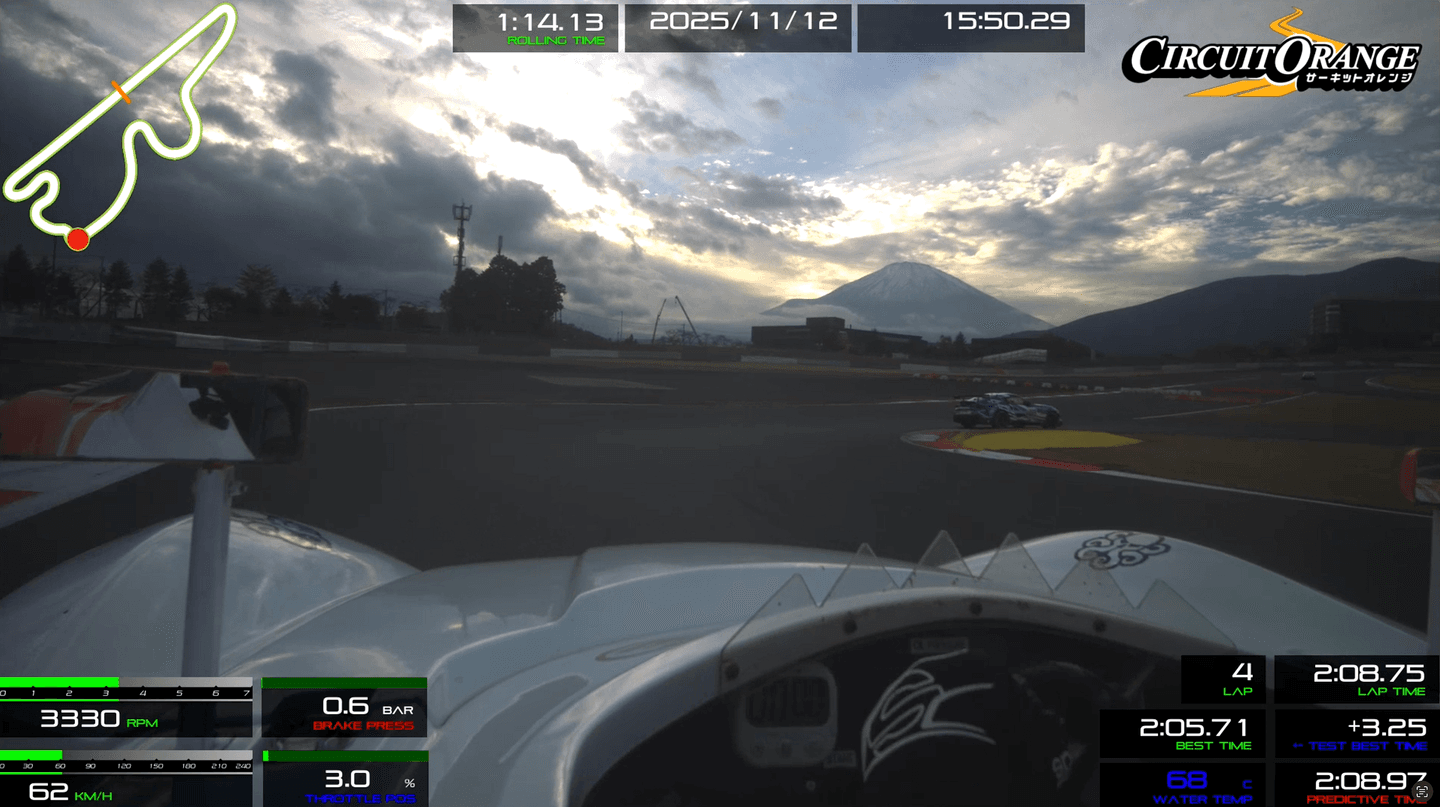
Onboard view from one of my laps in a VITA race car at Fuji Speedway (with the beautiful Mt. Fuji as amazing backdrop).
To be completely honest, I’m not even particularly interested in cars – at least not road cars. On public streets, I’d rather ride my motorbike. What excites me about racing is the obsession of both drivers and teams, the deep strategy and data, the cutting edge of engineering and tech, and the relentless drive to push yourself and the machine just a tiny bit harder to shave off that last fraction of a second.
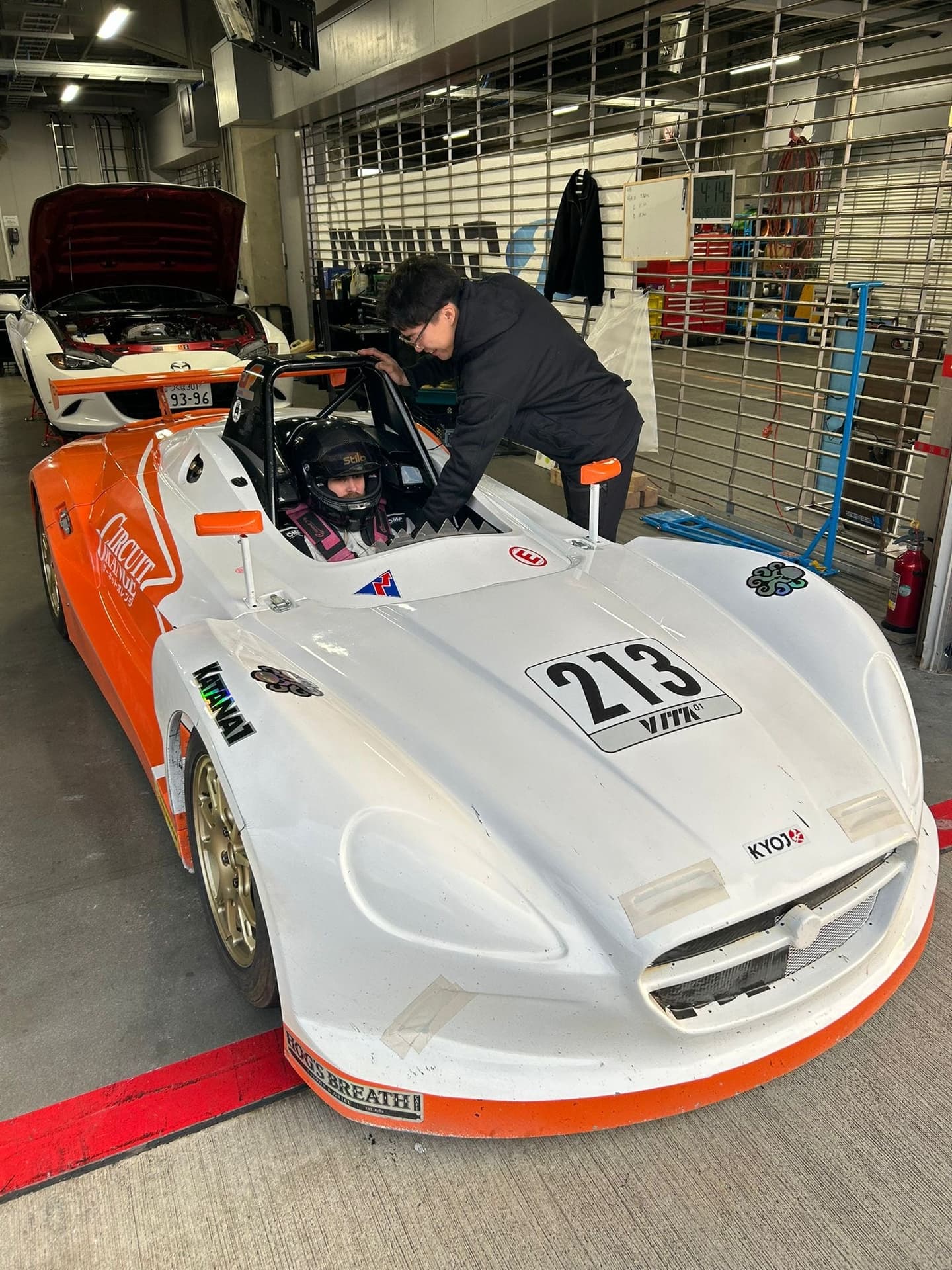
Me in the Circuit Orange VITA at Fuji Speedway getting strapped in for a track session.
And most importantly: the mental state it produces. After a session on track – real or simulated – I feel more refreshed than after almost any other activity. Not relaxed in the limp, passive sense. Refreshed in the sharp, clear-headed sense.
The Democratization of Flow
Here’s the practical problem: real motorsport is prohibitively expensive for most people. A single track day can cost what others spend on a week’s vacation (or more, depending on the car and your skill of keeping it in one piece). Building a competitive racing program requires resources that only a tiny fraction of enthusiasts can access.
But sim racing has changed this equation dramatically.
Modern sims like iRacing produce remarkably similar flow states to real racing. The physics are accurate enough that professional drivers use them for training. The immersion is complete enough that your brain responds as if the stakes are real.
I race in VR, and the experience is close enough to the real thing that the same psychological benefits apply. The control is just as immediate. The mastery curve is just as infinite. The detachment is just as complete – when you’re in a VR headset chasing a qualifying lap, there is absolutely no room for email anxiety.
The barrier to entry has dropped from “wealthy enthusiast” to “decent gaming PC and a wheel.” It’s not nothing, but it’s within reach for far more people than real track time ever will be.
The Missing Layer
The motorsports community is deeply data-obsessed (which is one aspect I love about it). Modern race cars and simulators generate extraordinary amounts of telemetry – speed, throttle position, brake pressure, steering angle, tire temperatures, thousands of data points per second. There are sophisticated tools for analyzing every aspect of how the car performed.
But there’s a gap.
All this telemetry tells you what happened. It doesn’t tell you why.
Why did you brake late into Turn 3 on lap 7? Was it confidence? Fatigue? A lapse in concentration? Did your heart rate spike before that spin, or after? Were you in flow during your fastest lap, or grinding through it on willpower?
The car’s data is extensively logged. But the driver’s data – their physiology, their mental state – is still largely untapped.
Understanding (and improving) human physiology is what I’ve been building toward with my work on biofeedback at Yudemon for several years now. And I’m extremely curious to bring this understanding to the racing world. Understanding not just what the car did, but what the driver was experiencing while it happened.
Telemetry shows what happened. Physiology shows why.
I’m calling this direction Yudemon ApexFlow, and I’ll be sharing more about it soon. If you’re curious about this intersection of human performance and motorsport, you can sign up here to stay informed.
The Rest Ethic Returns
One common trait among top performers is the ability to rapidly switch between two states: fully ON or fully OFF. Most of us spend our lives in some analog middle ground, half-on and half-off, never reaching either extreme and never experiencing the benefits that come from them.
Racing forces the ON state. Complete engagement, total presence.
And counterintuitively, this complete engagement is deeply restful. It delivers control, mastery, and detachment in concentrated form. Because it pushes everything else out of your mind and demands that you exist entirely in the present moment.
Good rest is not mere relaxation. It’s active and challenging. It demands our full attention. It stimulates us and gets us into flow states. It allows us to forget all our other concerns for a while, and be fully present in the moment.
For me, nothing delivers this more reliably than chasing the perfect lap.