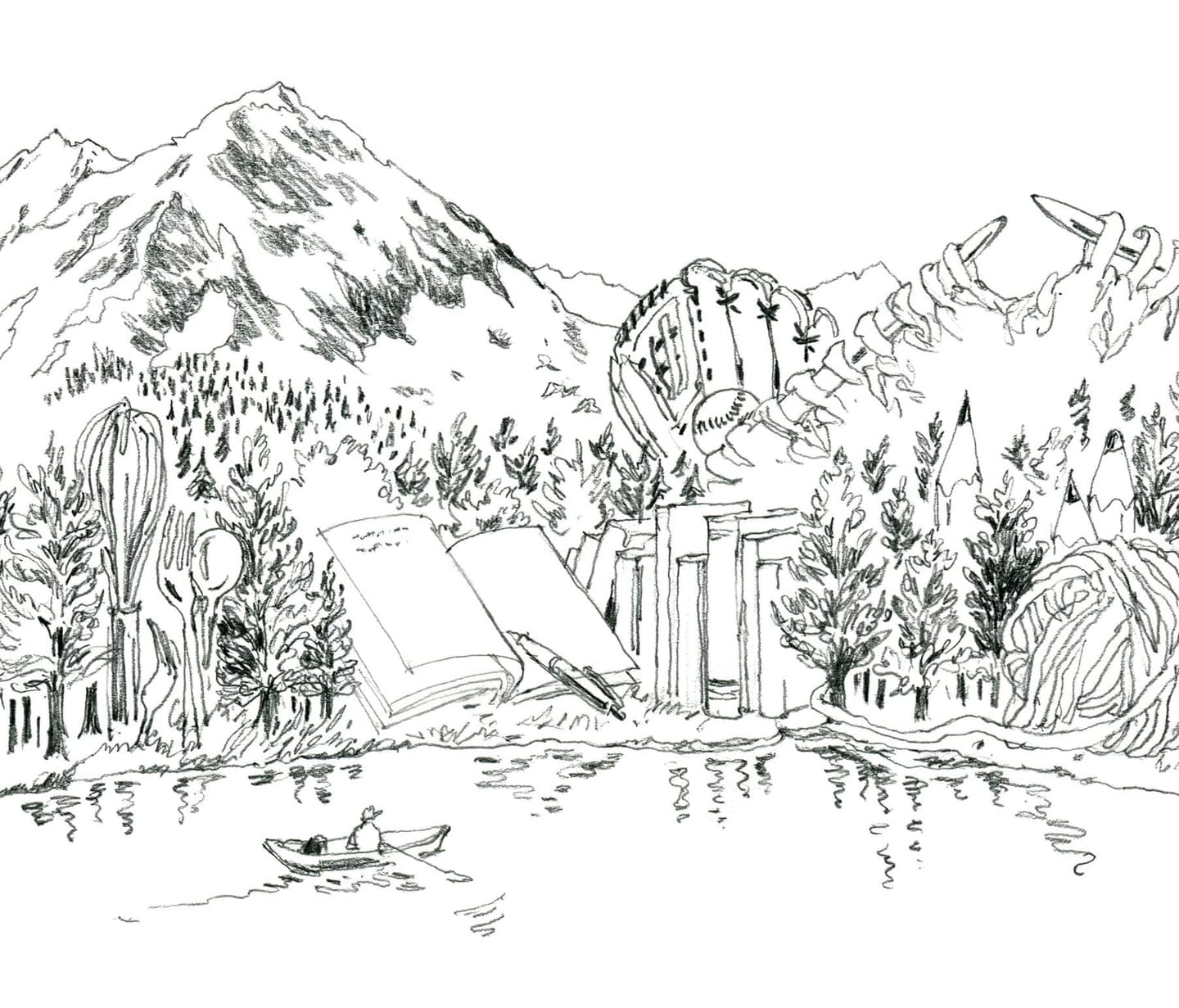
Illustration by Mariya Suzuki, courtesy of the authors.
Rest is commonly thought of as the opposite of work. We either rest, or we are productive. But the strict separation between work and rest is a modern misconception. If we define “work” as the entire process of productivity and creativity, not just as the thing most of us are supposed to be doing from 9 to 5, then rest is as integral a part of work as the obvious busywork we are all performing daily.
For a long time, it was assumed that the brain powers mostly down when we rest. However, when neuroscientists, armed with ever-improving brain imaging technologies, were actually able to observe brain activity, they saw something quite different. The 18th-century poet William Cowper was on to something when he wrote,
“Absence of occupation is not rest;
A mind quite vacant is a mind distressed.”
What researchers found was that a mind at rest is anything but vacant. Rather than an overall decrease in activity, the activity just shifts to different parts of the brain. These parts that activate during rest eventually became collectively known as the Default Mode Network (DMN).
With additional research, it soon became clear that the DMN is not only highly active, it is also crucially important. A study by the University of Southern California neuroscientist Mary Helen Immordino-Yang and her colleagues has found that DMN activity is highly correlated with intelligence, empathy, emotional judgment, and even overall sanity and mental health. Rest, it turns out, is critical to health, development, and, yes, to productivity.
Excellent work, particularly of the creative and innovative kind, needs rest and relaxation just as much as it requires time actively engaged in work. When we rest, our brain is busy consolidating memories, and quietly searching for solutions to problems we encounter. As the DMN kicks in, our intuition takes center stage and our creativity and problem-solving skills become more non linear, making more distant associations. If you have ever had a powerful daydream or epiphany while on a walk or in the shower, you can thank your DMN for that. In a moment that feels restful to you, your DMN is quietly seeking out big-picture strategies for the problems you’re trying to solve or the creative breakthrough you might be seeking. But if your mind is occupied with distractions, this process gets hindered. In that way, effective, deliberate rest is very different from just zoning out in front of the TV, mindlessly swiping on Tinder, or clicking from cat video to cat video on YouTube.
It has been shown that the brains of creative people have a more strongly developed DMN, allowing them to keep working more effectively when they rest. Interestingly, there are also specific areas in the DMN of creative people that are suppressed compared to the average population. The left temporoparietal region, which is responsible for subconscious idea evaluation, seems to be less active, suppressing fewer ideas, letting them instead rise up to the conscious mind. And this ultimately leads to those elusive aha moments.
Spending more time resting and less time actively engaged in work not only boosts creativity and happiness, it also makes the time spent on work more efficient. Web development company Basecamp (formerly 37 Signals) experimented with shorter work weeks, adding an additional day to the weekend, and found that
“just about the same amount of work gets done in four days vs. five days…. Three-day weekends mean people come back extra refreshed on Monday. Three-day weekends mean people come back happier on Monday. Three-day weekends mean people actually work harder and more efficiently during the four-day work week.”
Once you commit to making more time for rest, your work directly benefits. The self-imposed time constraint makes you focus on what’s essential. It makes you reevaluate the way you work and the methods you use. You become less likely to fall into the trap of visible busyness, actually getting stuff done rather than scheduling another pointless meeting or moving some images around in the presentation you are working on. You become more aware of the true value of your time, not just as a currency to exchange for money, but something valuable to you personally, something to be invested in any way you deem the most meaningful. And investing it in a variety of passions can be the key to making your creativity soar.
From Time Off: A Practical Guide to Building Your Rest Ethic and Finding Success Without the Stress by John Fitch and Max Frenzel, with illustrations by Mariya Suzuki. Published by Time Off LLC.
Copyright © 2020 by John Fitch and Max Frenzel